

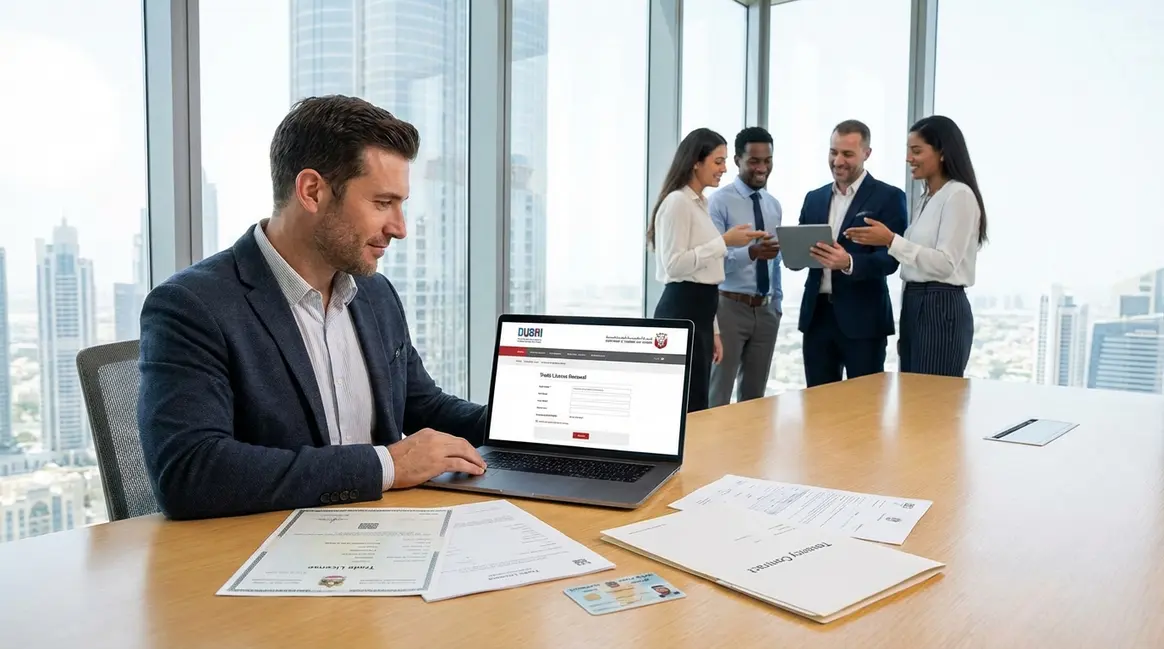
UAE Trade License Renewal Online: Step-by-Step by Authority (Dubai Mainland, Free Zones, Abu Dhabi & Sharjah)
Renewing a UAE trade license online is one of the fastest ways to stay compliant and avoid unnecessary penalties—but the “right” process depends on where your license was issued (Dubai mainland vs a specific free zone vs another emirate). This guide helps you choose the correct portal, prepare the required documents, understand realistic fee components, and renew early enough to avoid operational disruption.
Key Takeaways
- Start by identifying your issuing authority (DET vs free zone): Dubai mainland renewals run through DET/DED channels, while each free zone (and emirate like Abu Dhabi/Sharjah) has its own portal, fee schedule, and renewal rules—don’t assume a single unified UAE process, as explained in this mainland vs free zone company formation UAE guide.
- Follow the Dubai mainland (DET/DED) online renewal flow end-to-end: Confirm tenancy/Ejari where required via Ejari services, generate the renewal payment voucher through DET, pay online via approved channels, then download/receive the renewed license digitally.
- Prepare the “non-negotiable” renewal documents early: Common requirements include a valid tenancy contract/Ejari (where applicable) through Ejari, passport/Emirates ID copies of partners/manager via Emirates ID information, trade license copy, and any approvals tied to regulated activities—missing one item is the most common reason renewals stall.
- Use a cost breakdown mindset, not a single “renewal fee”: The cost to renew a DED/DET trade license in Dubai often combines license issuance/renewal charges, activity approvals, tenancy/Ejari-related costs, and additional service items—calculate your total using a Dubai trade license cost framework.
- Treat Abu Dhabi renewals as a separate fee structure: An Abu Dhabi trade license renewal fee breakdown typically differs by activity and authority (mainland vs free zone). Confirm the exact government and service fees in the relevant portal before payment to avoid budgeting surprises (compare renewal logic using this trade license guide and the official Doing business in the UAE portal).
- Renew Sharjah free zone licenses inside the free zone portal: If you’re searching “how to renew Sharjah free zone license,” expect a free-zone-managed workflow (not DET), usually requiring an online application, lease/facility confirmation, and payment through the zone’s system (see typical facility dependencies in this free zone setup cost guide).
- Late renewal gets expensive fast—plan for penalties and knock-on effects: Late fees for expired trade license UAE can apply per authority and can trigger blocked immigration/visa processes via ICP, difficulty renewing establishment cards, and interruptions to invoicing and banking.
Contents
- Identify Your Issuing Authority
- Dubai Mainland (DET/DED) Renewal: Step-by-Step
- Documents Checklist for UAE Trade License Renewal
- Cost to Renew a Dubai DED/DET License: Breakdown Mindset
- Abu Dhabi Renewal: Separate Portal, Separate Fees
- Sharjah Free Zone Renewal: Portal-Based Workflow
- Deadlines & Grace Periods
- Late Fees & Operational Impact
- Special Cases: Virtual Offices & Multi-Jurisdiction
- When to Use a Renewal Agency
- Strategic Wrap-Up
Start With the One Decision That Controls Everything: Who Issued Your License?
A “quick” online renewal can turn into days of back-and-forth if you start in the wrong portal—or miss one document that your issuing authority won’t waive. The UAE doesn’t run a single unified renewal system: Dubai mainland licenses follow DET/DED channels, while each free zone (and emirates like Abu Dhabi or Sharjah) uses its own rules, fees, and timelines, as outlined in this mainland vs free zone company formation UAE guide.
Reality check: “Submitted” isn’t the finish line. The finish line is an issued license you can download and share with banks, clients, platforms, and government systems.
Where to find the issuing authority on your trade license
Check your current trade license and look for these cues:
- Header/logo/seal: DET/DED branding indicates Dubai mainland; a free zone’s name/logo indicates zone-issued.
- Authority name in the body text: Often written near “Issued by,” “Licensing Authority,” or similar.
- License number format/reference: Some authorities use distinctive formats or include an authority code.
- Portal references: URLs, QR codes, or “verify at” notes often point to the correct online system.
Mini-check: if your document says DET (Dubai Department of Economy and Tourism) or references DED (legacy naming used widely for Dubai mainland licensing), treat it as Dubai mainland (DET/DED) unless your license explicitly states a free zone.
Choose the correct online renewal portal (there’s no unified UAE portal)
- Dubai mainland (DET/DED): Renew through DET/DED-approved channels and linked government systems for licensing and related validations (for example, tenancy/Ejari where applicable).
- Free zones: Renew through that free zone’s portal. Each zone has its own workflow, facility/lease rules, and invoices (see common patterns in this free zone setup cost guide).
- Other emirates (e.g., Abu Dhabi, Sharjah): Use emirate-specific portals for mainland, and each free zone’s portal for zone licenses.
If you’re unsure, don’t guess—verify by cross-checking the authority name on the license against the login page/portal branding before you upload documents or pay. Once you’ve confirmed your authority, the renewal becomes a structured sequence rather than trial-and-error.
Dubai Mainland (DET/DED) Trade License Renewal Process Online (Step-by-Step)
This section covers the Dubai mainland workflow—often referred to as DED license renewal and now under DET trade license services on DET/DED. Exact screens and labels can change, but the sequence below is the reliable path for completing the Dubai trade license renewal process online (and aligns with the practical structure described in this Dubai trade license guide).
Pre-renewal checks to avoid a stalled renewal
- License status: Confirm whether it’s active, near expiry, or already expired (status affects penalties and sometimes additional steps).
- Business activities: Ensure listed activities match what you operate; mismatches can trigger extra approvals.
- Outstanding fines/blocks: Unpaid fines or compliance blocks can prevent issuance even if payment is made.
- Partner/manager details: Update contact info and authorized signatory/manager details so OTPs and notifications route correctly.
Mini-FAQ: Can I renew if my license is already expired?
Typically yes, but you may need to clear penalties/blocks first and follow portal prompts. Avoid paying “blindly” until the portal confirms your renewal can be issued after payment.
Step 1: Confirm tenancy/Ejari requirements (where applicable)
For many Dubai mainland licenses, premises validation is a core dependency. Confirm:
- Your tenancy contract validity aligns with the renewal window.
- Ejari (if required) is valid and correctly linked to the business details using Ejari services.
If your tenancy is expiring soon, renew/extend it first. An outdated Ejari or mismatched unit details (unit number, building name, tenant name) is one of the most common reasons the portal won’t complete the renewal flow.
Virtual office scenario (Dubai mainland): In some setups, Ejari may not apply the same way as it does for a traditional leased office. Requirements vary by authority-accepted premises model and your activity. If Ejari isn’t applicable, you may need alternative premises evidence accepted by the licensing authority—follow the prompts shown during your renewal journey.
Step 2: Gather and upload required documents
Prepare clear, readable scans before you start uploading:
- Use consistent file naming (company name + document type + date).
- Upload in common formats (typically PDF/JPG) with legible text and uncut edges.
- Ensure names match across documents (English/Arabic spellings can matter).
If the portal prompts for an activity approval, treat it as a prerequisite, not an optional upload—especially for regulated activities (for example, healthcare clinics, finance-related services, education providers, and certain environmental services may require ongoing approvals depending on activity classification).
Step 3: Generate the DET renewal payment voucher
Once prerequisites validate, the system typically generates a renewal payment voucher (or equivalent payment instruction). Ensure these details match your license records:
- Company name and license number
- Activity list and any required approvals
- Tenancy/Ejari linkage (where applicable)
- Manager/partner details used for authorization
Common voucher issues (and what they often indicate):
- Tenancy date conflicts: Tenancy/Ejari needs renewal or relinking.
- Missing approvals: An external NOC/approval is required before payment results in issuance.
- Outdated manager info: The system can’t validate authorization or route notifications properly.
Step 4: Pay renewal fees online via approved channels
Pay through the methods shown in your renewal journey (commonly card payments and official e-payment channels). To avoid duplicate charges and delays:
- Don’t refresh the payment page mid-transaction.
- Save the payment confirmation/receipt reference.
- If you don’t see immediate confirmation, re-check the portal status before attempting to pay again.
Processing times can be near-immediate or take time to reflect, depending on the channel and system synchronization. If the portal shows “paid” but the license isn’t available, check for post-payment issuance steps or pending validations.
Step 5: Download/receive the renewed license digitally
After successful issuance, retrieve the renewed license as a digital document in your portal account.
Next operational steps after you renew:
- Update your bank and payment processors if they request the latest license copy.
- Share the renewed document with key vendors/marketplaces that require valid licensing.
- File it internally for compliance and future renewals (along with linked permits/approvals).
Mini-FAQ: Do I need a physical stamp or printed license?
Many authorities provide digital licenses, but third parties (banks, platforms, clients) may have their own format expectations. Keep a clean digital copy and be ready to print if requested.
Documents Needed for UAE Trade License Renewal (Checklist You Can Prepare Early)
The documents needed for UAE trade license renewal are similar in concept across authorities, but the exact list differs by issuing authority (DET mainland vs each free zone vs other emirates). Prepare early, then follow your portal prompts for anything activity-specific.
“Non-negotiable” documents commonly required across authorities
- Current trade license copy
- Passport and/or Emirates ID copies of partners/shareholders and the manager (as applicable) using Emirates ID information
- Proof of premises:
- Tenancy contract/Ejari (often for mainland, where applicable) via Ejari services
- Free zone facility lease/desk agreement (for free zones)
If IDs are close to expiry, renew them where possible—expired IDs are a frequent cause of renewal delays and verification failures.
Activity-specific and regulated approvals (often the real bottleneck)
For regulated activities, the renewal can depend on valid external approvals. Examples (vary by activity/authority) include:
- Sector regulator approvals/NOCs
- Municipality-related certificates
- Civil defense-related requirements for certain premises/activities
- Other linked permits that must remain valid before the license can be renewed
Practical rule: if your business required an external approval to start or to amend activities, expect renewal to be tied to ongoing validity of that approval.
Cross-industry note: This approval dependency shows up across many sectors—healthcare (patient-facing clinics and labs), finance (activities where compliance and fraud controls matter), education (training providers and certification), legal (compliance-driven services), marketing (regulated ad categories), retail (special product approvals), and environmental services (waste handling and monitoring). The portal isn’t just renewing a license—it’s validating that your activity still meets the rules.
Free zone and virtual office “proof of address” requirements
Free zones and flexible workspace models often use a different “proof of address” concept than Ejari:
- Free zone lease/facility agreement (flexi-desk, office, warehouse)
- Facility confirmation letters or portal-generated tenancy confirmations
- Invoice clearance for the facility package (in some zones)
In many free zones, the facility/lease renewal must be completed (or at least valid) before the license renewal can be issued.
Common document mistakes that delay online renewal
- Expired IDs (Emirates ID, passport) or unclear scans
- Mismatched names across ID, license, and tenancy/facility documents
- Missing signatures/stamps where the authority still requires them
- Incorrect tenancy details (unit/building, tenant name) or outdated Ejari
- Activity list inconsistencies (what’s on the license vs what you’re renewing)
If you want the renewal to be fast, aim for “boring accuracy”: identical spelling, clean scans, and documents that remain valid through the renewal period.
Cost to Renew DED Trade License Dubai (Use a Cost Breakdown Mindset)
If you’re searching for the cost to renew a DED/DET trade license in Dubai, avoid expecting a single fixed number. Renewal totals are usually a bundle of categories that vary by activity, approvals, premises status, and compliance. The best approach is to estimate by components—so the checkout screen doesn’t surprise you (use this Dubai trade license guide as a baseline reference).
What “renewal fees Dubai” typically include (not a single line item)
- Base license renewal charges
- Government service charges that may appear as separate items (often including knowledge/innovation/service-type fees, depending on workflow)
- Activity approvals and any linked business activity permit renewal costs
- Tenancy-related costs outside the portal (tenancy renewal, Ejari-related steps where applicable)
- Penalties if the license is expired or if compliance issues appear in the system
Because some items are prerequisites (approvals, tenancy), your “renewal cost” can be split between the portal payment and external renewals you must complete first.
Practical cost drivers: what moves your total up or down
Instead of relying on a generic number, use these cost drivers to predict whether you’ll be on the lower or higher end:
Higher-cost drivers:
- Multiple activities and multiple linked approvals
- Regulated activities requiring external renewals/NOCs
- Late renewal penalties and compliance blocks
- Tenancy/Ejari updates needed due to mismatches or expiries
- Additional permits tied to the activity
Lower-cost drivers:
- Single activity with no external approvals
- Clean compliance record (no fines/blocks)
- Valid tenancy/Ejari already linked correctly (where applicable)
- Up-to-date manager/partner details and IDs
Mini-FAQ: How much does trade license renewal cost in Dubai?
It varies widely based on authority, activity approvals, tenancy, and penalties. The most accurate method is to review the portal-generated voucher/fee items after prerequisites validate, then add any external costs (Ejari/tenancy and approvals). Refer back to this Dubai trade license guide for context on typical cost components.
How to estimate your total renewal cost before you click “pay”
- Base renewal: what the portal shows once your license is selected.
- Approvals: list every activity approval you currently maintain; confirm which must be renewed first.
- Tenancy/facility: confirm whether you must renew tenancy/Ejari (mainland) or facility lease (free zone) before issuance.
- Penalties: check if the system shows fines/blocks due to expiry or compliance issues.
- Service support (optional): if using a consultant/agency, keep their fee separate from government fees.
Budgeting tip: Prioritize “must-pay-to-issue” items first (portal voucher + mandatory approvals). Treat tenancy/facility renewal as a parallel cost line, not an afterthought.
Abu Dhabi Trade License Renewal Fee Breakdown (Separate Structure, Separate Portal)
Abu Dhabi renewals require a different mental model: separate authority, separate portal, separate fee table. If you’re comparing an Abu Dhabi trade license renewal fee breakdown to Dubai, treat them as two different systems even if the business activity sounds similar. For official orientation on business services, refer to the Doing business in the UAE portal.
Mainland vs free zone in Abu Dhabi: why fees differ
In Abu Dhabi, renewal pricing and steps differ depending on whether your license is:
- Mainland-issued (by the emirate’s mainland licensing authority and related systems)
- Free zone-issued (by the specific Abu Dhabi free zone authority)
Each has its own service fees, government charges, facility/lease dependencies, and approval requirements for regulated activities.
What to confirm before you pay
- The correct activity list and linked fees are reflected
- Required approvals are marked valid (or the system shows how to update them)
- Lease/tenancy dependencies are satisfied (mainland tenancy vs free zone facility rules differ)
- No outstanding fines/blocks prevent issuance
If a payment request is generated but the license remains “blocked,” resolve the blocker first; otherwise you risk paying and still not receiving the issued renewal until dependencies clear.
Budgeting pitfalls to avoid
- Assuming Dubai (DET/DED) steps apply in Abu Dhabi
- Assuming Dubai pricing patterns map onto Abu Dhabi fee items
- Paying “base” charges while approvals/lease status still prevent issuance
- Underestimating the cost/time of regulated approvals that renew on different schedules
How to Renew Sharjah Free Zone License (Portal-Based Workflow)
If you’re asking how to renew a Sharjah free zone license, plan around two pillars: your zone portal and your facility/lease status. While each Sharjah free zone has its own interface, the workflow is typically consistent (see common facility-linked renewal patterns in this free zone setup cost guide).
Typical Sharjah free zone online renewal steps
- Log in to your free zone customer portal and select the license to renew.
- Confirm your facility/lease is active (flexi-desk, office, warehouse) and aligned with the renewal period.
- Upload requested documents (IDs, license copy, approvals if applicable).
- Review fee items and submit the renewal request.
- Pay through the portal payment gateway.
- Download the renewed license and related documents once issued.
Because facility packages are central in free zones, renewals may not proceed if facility invoices are overdue or if the lease term doesn’t cover the renewal period.
Documents commonly required by Sharjah free zones
- Trade license copy
- Shareholder/manager passport/Emirates ID copies
- Facility lease/flexi-desk agreement or confirmation
- Activity approvals if your activity is regulated
Common reasons Sharjah free zone renewals are delayed
- Expired facility lease or mismatched facility details
- Missing compliance documents requested by the zone (varies by zone and activity)
- Unresolved invoices/fees tied to the facility package or services
- IDs expired or unclear scans causing verification failures
Mini-case (qualitative): A small trading company in a Sharjah free zone attempted renewal before extending its flexi-desk package. The portal accepted the request but held issuance until the facility invoice was settled and the lease term was extended—delaying vendor onboarding that required a valid license copy.
Deadlines, Grace Periods, and Why Timing Is a Compliance Tool
Deadlines are not uniform across the UAE. The trade license renewal grace period in Dubai and any grace period in other emirates or free zones can differ by authority and license type. Treat grace periods as uncertain buffers, not a strategy.
When to start renewal (timelines that reduce risk)
- Start preparing documents and checking dependencies several weeks before expiry, especially if your activity needs external approvals or tenancy changes.
- If you have regulated activities or a complex structure (multiple partners/activities), start earlier to leave room for approval renewals and corrections.
What matters is not just submission time, but whether all prerequisites validate before expiry.
How grace periods work (and why you shouldn’t rely on them)
Grace periods (if offered) are authority-defined and can change. Typically:
- They may allow processing after the expiry date, but penalties may still apply depending on rules.
- They do not guarantee uninterrupted operations—banks, platforms, and enterprise clients may refuse expired licenses regardless of grace.
Verify grace period rules in your issuing authority’s portal notices via DET/DED, your voucher notes, or official communications.
What can block an “on-time” renewal even if you started early
- Tenancy/Ejari timing conflicts or mismatched unit details
- External approvals not renewed yet (or renewed but not reflected in the system)
- Unpaid fines or compliance blocks
- Manager/partner info mismatches preventing validation
- System synchronization delays between linked platforms
End-of-section reality check: “Submitted” is not the same as “renewed.” The real finish line is an issued license available to download.
Late Fees for Expired Trade License UAE: Penalties and Knock-On Effects
When people search late fees for expired trade license UAE, they often focus only on the fine. In practice, the bigger cost can be disruption: visas, banking, contracts, and platform accounts may require a currently valid license. Penalty rules and escalation are authority-dependent, so always check your issuing portal for the exact items applied.
What late renewal can trigger beyond the fine itself
- Accumulating penalties depending on authority rules and how long the license remains expired
- Operational blocks restricting updates, amendments, or linked services until renewal completes
- Visa/immigration disruptions and delays for establishment-related processes in some cases (see official guidance via visa and Emirates ID services)
- Commercial friction with banks, payment providers, marketplaces, landlords, and enterprise clients
- Contract/invoicing issues where counterparties refuse to sign, renew, or pay against an expired license
If your business relies on continuous invoicing or platform access, treat renewal as operational continuity—not only compliance.
How to recover from an expired license (online-first, authority-dependent)
- Go to the correct issuing authority portal (DET/DED, free zone portal, or other emirate portal) via DET/DED where applicable.
- Check for displayed fines/blocks and clear what the portal requires first.
- Validate prerequisites (tenancy/Ejari or facility lease, plus approvals).
- Regenerate the payment request/voucher if needed.
- Pay, confirm issuance, then download the renewed license.
In some cases after a lapse, additional steps may apply (revalidation of approvals or inspections depending on activity and authority). Follow portal prompts closely and avoid partial uploads that trigger rejections.
Prevention plan to avoid repeated late renewals
- Assign a single owner for renewal tracking (finance/admin or operations)
- Set calendar reminders (60/45/30/14 days before expiry)
- Track tenancy/facility expiry separately from license expiry
- Maintain a renewal folder with current IDs, lease documents, and approvals
- Review approvals quarterly if your activity is regulated
Special Cases: Virtual Offices, Flexi-Desks, and Multi-Jurisdiction Setups
Online renewal is possible for many non-traditional setups, but the key is knowing what the authority treats as valid “premises proof” and how approvals sequence. This is where one-size-fits-all advice causes failed renewals.
Renewing with a virtual office or free zone facility package
Can I renew a trade license online if my office is virtual or in a free zone?
Typically yes—but you must use the correct authority portal and provide authority-accepted premises evidence (Ejari for some mainland cases; facility/lease confirmation for free zones and many flexi-desk models). See common facility documentation patterns in this free zone setup cost guide.
What often replaces Ejari in free zones/flexi-desks:
- Facility lease agreement (desk/office/warehouse)
- Free zone-issued facility confirmation generated from the portal
- Cleared facility invoices tied to the package
Common misunderstandings that cause rejections:
- Uploading facility confirmations in a mainland workflow that expects Ejari (or vice versa)
- Facility lease term not covering the renewal period
- Activity requiring a specific facility type (e.g., warehouse) that doesn’t match the package
Companies with multiple activities or special approvals
Multiple activities can increase both timeline and cost because each activity may carry an approval dependency. This is especially common for e-commerce and mixed activity models (see an activity-focused example in this e-commerce license guide).
Sequencing rule of thumb:
- Renew external permits/approvals first (business activity permit renewal where applicable).
- Ensure tenancy/facility proof is valid and aligned.
- Then renew the trade license in the portal.
If you reverse the order, you risk generating a voucher that can’t produce issuance until approvals are valid—or being unable to generate the voucher at all.
Cross-authority businesses (Dubai + other emirates/free zones)
If your business operates across Dubai mainland plus a free zone entity—or across multiple emirates—keep renewals separated by entity and issuing authority:
- Separate portal logins
- Separate fee schedules
- Separate premises/lease dependencies
- Separate penalty regimes and timelines
Mini-case (qualitative): A group with a Dubai mainland entity and a free zone entity tried to “sync” renewals using the mainland tenancy timeline. The free zone renewal stalled because the facility package renewal was a separate prerequisite, prompting a last-minute scramble for facility confirmation and delaying internal compliance updates.
When to Use a Business Setup Agency for License Renewal Dubai (and What to Expect)
A business setup agency for license renewal Dubai can be helpful when renewal is no longer a simple “pay-and-download” task. The key is knowing when agency cost is justified by reduced downtime, fewer rejections, and faster handling of approvals and document coordination (see a broader support framework in this step-by-step business setup guide).
Situations where an agency is cost-effective
- Multiple activities with regulated approvals and external NOCs
- An expired license with fines/blocks you need to clear correctly
- Tenancy/Ejari mismatches requiring coordination and revalidation
- Cross-authority renewals (Dubai mainland + free zones or other emirates)
- Internal capacity constraints (no admin team to chase documents and portal updates)
What an agency typically handles vs what you must still provide
What an agency typically handles:
- Preparing and submitting the online renewal application in the correct portal
- Coordinating follow-ups with the relevant authority or free zone
- Guidance on prerequisites (tenancy/Ejari or facility lease alignment)
- Coordinating approvals/permits renewal sequencing
- Payment coordination steps (while keeping you in control of official payments where required)
What you must still provide:
- Current IDs (passport/Emirates ID) and company information
- Authorizations/signatures if the portal or authority requires them
- Tenancy/facility documents and any landlord/free zone lease renewals
- Timely responses for OTPs/verification steps if the portal uses them
How to choose the right renewal support partner
- Ask for a fee breakdown separating government fees, approvals costs, tenancy/facility costs, and the agency’s service fee.
- Confirm they cover your exact authority type (DET/DED mainland vs your free zone vs other emirate).
- Get clear expectations on turnaround and what could delay it (approvals, tenancy, expired documents).
Red flags: vague “all-in” pricing with no itemization, unclear accountability for portal access/payment references, and promises that ignore authority-dependent rules.
If you proceed yourself, reuse the same decision framework an agency would: confirm authority first, clear prerequisites second, then pay only when issuance is actually unblocked (reference structure in this Dubai trade license guide).
Strategic Wrap-Up: Build Renewal Around Your Real Blockers, Not Just the Expiry Date
Renewing a UAE trade license online isn’t a single, universal process—it’s an authority-specific workflow where the first decision (who issued your license) determines everything that follows, as explained in this mainland vs free zone company formation UAE guide. Whether you’re dealing with Dubai mainland through DET/DED, a free zone, or another emirate, successful renewal hinges on clearing prerequisites before you pay: valid premises proof (Ejari via Ejari services or a facility lease), up-to-date IDs and manager details, and any regulated activity approvals that act as true gatekeepers to issuance.
Costs behave the same way—rarely a flat figure, more often a bundle shaped by approvals, tenancy, penalties, and compliance status. The most reliable strategy is to treat renewal as operational continuity: start early, validate dependencies, and aim for an issued, downloadable license—not just a submitted application.
Future-focused challenge: As licensing systems become more interconnected with immigration, banking compliance, and digital onboarding, renewals will increasingly behave like a “live” compliance score rather than a once-a-year admin task. Are your renewal reminders built around your real blockers (approvals, premises validity, ID expiry, and portal validation), or just the calendar expiry date?
FAQ
Is there one unified UAE portal to renew any trade license online?
No. The UAE renewal process is authority-specific. Dubai mainland uses DET/DED channels, while each free zone (and each emirate’s mainland authority) runs its own portal, rules, and fee items.
How do I confirm if my license is Dubai mainland (DET/DED) or free zone?
Check your current trade license for the issuing authority name/logo and any “Issued by” reference. DET/DED branding typically indicates Dubai mainland; a free zone name/logo indicates zone-issued. If still unsure, match the authority name on the license with the portal branding before uploading documents or paying.
Is Ejari required for Dubai trade license renewal online?
Often yes for Dubai mainland where premises validation applies, but it depends on your license setup and activity. If required, use Ejari services to ensure the tenancy is valid and matches your business details. For some virtual/flexible setups, alternative premises proof may apply based on portal prompts.
What are the most common documents needed for UAE trade license renewal?
Common requirements include your current trade license copy, passport/Emirates ID copies (see Emirates ID information), and premises proof (Ejari/tenancy for many mainland cases or facility lease confirmation in free zones). Regulated activities may require valid external approvals.
Why does the “cost to renew DED trade license Dubai” vary so much?
Because the total is typically a bundle: base renewal charges, service items, activity approvals, tenancy/Ejari-related costs, and penalties (if expired/blocked). The most accurate estimate comes from the portal-generated voucher after prerequisites validate, plus any external costs. For a component view, see this Dubai trade license guide.
What happens if my UAE trade license expires—can it affect visas?
Depending on the issuing authority and your business setup, an expired license can trigger operational and administrative disruption, including delays or blocks in some establishment/visa processes. Use official references for immigration and related services via ICP and the visa and Emirates ID services portal.
When should I use a business setup agency for license renewal in Dubai?
Consider it if you have multiple regulated activities, an expired license with fines/blocks, tenancy/Ejari mismatches, cross-authority entities, or repeated portal rejections. If you want a reference point for how agencies structure processes, see this step-by-step business setup guide.
Book a free consultation
Get a clear view of the right setup, structure, and compliance steps for your case.

